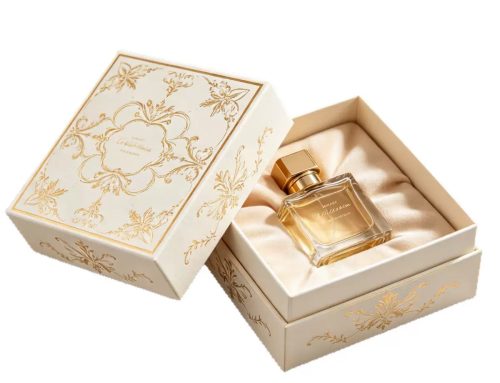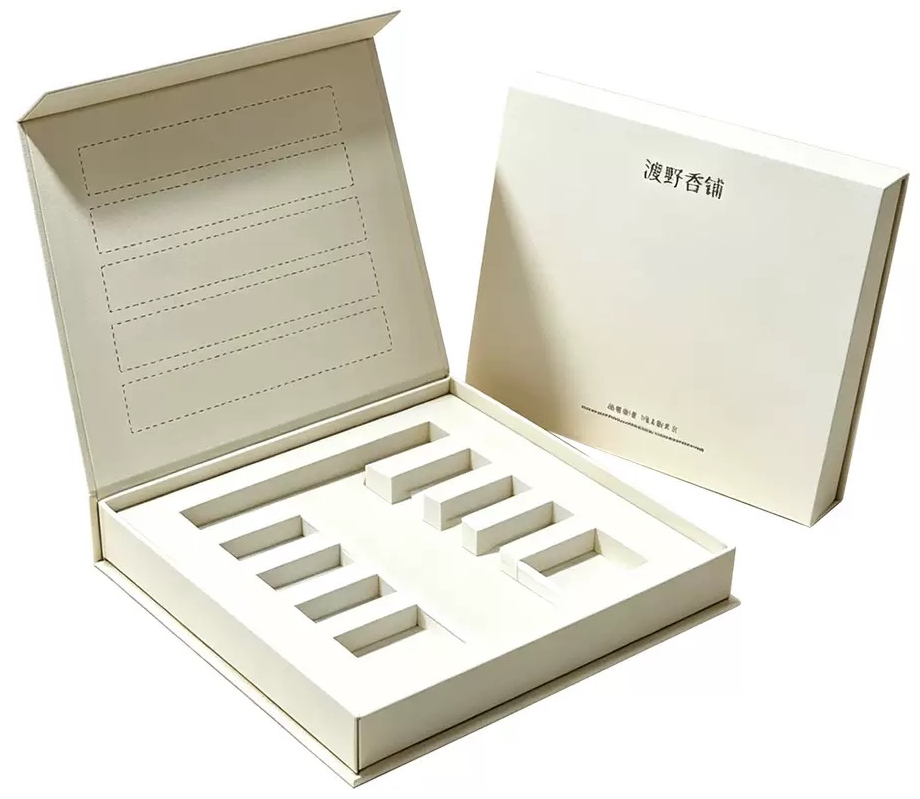
This type of box belongs to a typical paper packaging box. Judging from the visual texture (white, stiff, matte or semi matte surface) and the faintly visible words “paper handmade box” in the table on the right, it is most likely one of the following common materials:1. White Cardboard – the most common
This is the most commonly used substrate for this type of minimalist style gift box, especially for mid to high end cosmetics or medical beauty brands.
• Features: The texture is hard and thick, with high whiteness, a smooth and even surface, good folding resistance, and not easily deformed.
Application: Suitable for making boxes with upper and lower lid structures, it can support the box shape well, with high printing color saturation, and the surface can be treated with lamination (matte or glossy film), hot stamping, UV and other processes, making it look very high-end.
Weight: usually around 300g-400g (harder if there is a gray board in between), if it is double layered white cardboard (commonly known as double gray board), the thickness can reach 1mm or more, and the stiffness is higher.
2. Grey Board+Specialty Paper – thicker/high-end
• Features: The middle is made of gray cardboard (grey board), with a layer of white face paper (which may be special paper, art paper, or white cardboard) mounted on the outside.
Application: This material is thicker and feels better than pure white cardboard, making it suitable for making handmade boxes that have a “heavy feeling” when opened, giving people a solid and high-end feeling.
3. Art Paper/Specialty Paper
• Features: The surface may have subtle textures (such as cloth, wood, leather, etc.), which are more tactile and textured than ordinary white cardboard.
Application: In order to increase the level and uniqueness of packaging, many designers choose this textured special paper to make the box surface. Although it looks relatively flat in the picture, if it is a matte effect, it may also be a delicate special paper.
4. Fluated Paper/Micro corrugated Paper
• Features: The surface has tiny wave patterns, and there is an air cushion layer inside.
Application: This material has good cushioning performance and is suitable for making packaging boxes that need to protect internal items (such as fragile items). But from the picture, the surface of this box is very flat, not like coarse corrugated paper, but it is possible to use E-corrugated or F-corrugated fine corrugated paper because it combines lightness and a certain degree of cushioning.
5. Inner part
The groove bracket inside the box (used to hold bottles and cans) is usually used:
EVA inner tray: With good cushioning and strong shape flexibility, it can tightly adhere to products and is commonly used in cosmetics and medical device packaging.
Paper inner tray: environmentally friendly, low-cost, with grooves made through die-cutting or indentation.
Vacuum formed inner tray: transparent or black, but if it is fully paper packaging, the possibility of vacuum forming is relatively low.
6. Clues in the table on the right
There is a vertical table on the right side of the picture, where you can see words such as “paper handmade box”, “material”, “craftsmanship”, etc. This further confirms that this is a paper box and a handmade box (i.e. not a folding box, but a hard box that needs to be glued together).
Summary and Suggestions
If you are doing design or inquiry, white cardboard (350g-400g) is the most reliable and cost-effective choice; If you pursue a higher quality texture, you can consider using grey board paper to mount special paper; If it is a medical or precision instrument, it is recommended to pair it with EVA to ensure that the product will not shake or be damaged during transportation.
This type of box has a simple and modern style, which is very suitable for medical beauty, skincare products, or high-end consumer goods. The material selection should mainly focus on paper with good stiffness, good printing effect, and delicate surface texture.
Leave your comment
Related posts